How Much Does an AI Voice Agent Actually Cost?
How Much Does an AI Voice Agent Actually Cost?
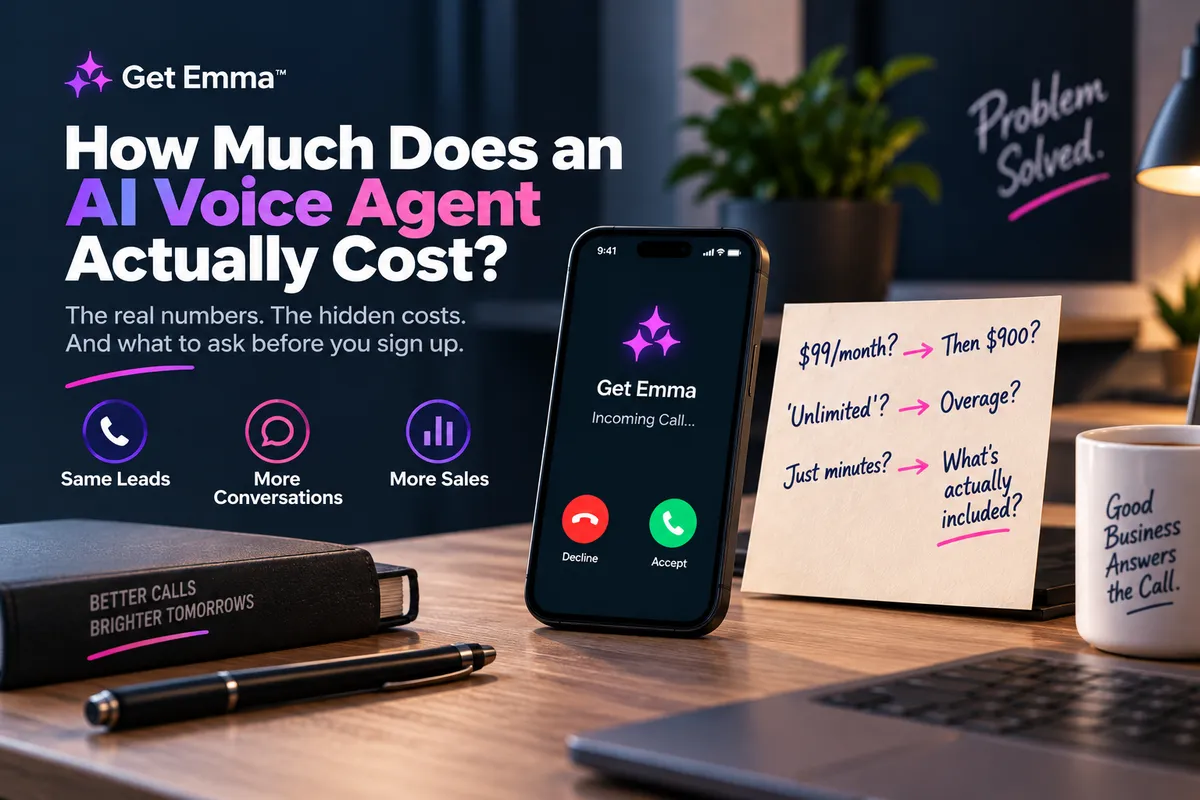
You've probably seen the ads. "AI voice agent from $99 a month." Sounds simple. Sounds cheap.
Then three months in, the bill's $900. Then $1,500. You call to ask why, and someone explains something about "minutes" and "tokens" and "overage." You still don't really know what happened.
This is one of the most common traps in AI voice agent pricing, and it's worth understanding before you sign up for anything.
Why the sticker price is rarely the real price
Here's roughly what's going on behind the scenes every time your AI voice agent takes a call:
The phone line itself costs money, per minute, just like any phone call
Turning speech into text so the AI can understand what's being said costs money
The "thinking" part, the AI working out what to say back, is billed per unit of processing (this is where "tokens" come in)
Turning the reply back into a voice costs money too
Some providers also add their own margin on top of the raw AI processing cost, on top of everything else. This is common practice, not a secret or a scam, but it's rarely visible on a pricing page. It's part of why the exact same conversation can cost noticeably different amounts depending on which platform is running it behind the scenes.
Add all of that up, and the real cost per minute is often two to four times higher than the number advertised. One recent industry review found agents advertised at $0.07 a minute were actually costing businesses $0.12 to $0.33 a minute once everything was included.
The three common ways businesses get pricing shocks
1. Pay-per-minute, no cap.
You're charged for every minute of every call, with no upper limit. Fine in a quiet month. Painful the month your ads work really well and the calls double.
2. A monthly plan with a small bucket of minutes, then steep overage.
This one catches people out the most. One well-known provider charges $59 a month, but that only covers 100 minutes, which is about 30 to 50 calls. Go over, and you're paying per extra minute on top. Another charges $99 a month for just 50 minutes, which works out to roughly $2 a minute once you do the maths.
3. "Unlimited" that isn't really unlimited.
Some plans cap "unlimited" at a certain number of minutes or tokens before overage kicks in, and it's not always obvious from the pricing page.
None of this makes these companies dishonest. It's just how the technology is priced. But if you're a business owner trying to budget, it means the $99 headline number tells you almost nothing about what you'll actually pay in month three.
What to actually ask before you sign up
What happens to my bill if my call volume doubles next month?
Is the quote a flat fee, or does it move with usage?
Is there a margin added on top of the raw AI processing cost, and if so, how much?
What's included in "unlimited," and what triggers extra charges?
Can I see what a typical customer's bill looks like in their busiest month, not their quietest one?
If a provider can't answer these clearly, that's worth noting.
So is it actually worth it? A simple way to work out AI voice agent ROI
Forget the pricing page for a second. The real question is simpler: will it make you more money than it costs?
Here's a rough, honest way to think about it. Say your average sale is worth $3,000, and normally, out of every 10 people who actually get a proper conversation with your business, 3 or 4 book in. That's a good, realistic close rate for a lot of businesses.
Now say an AI voice agent picks up 15 calls a month that would've otherwise gone to voicemail, or follows up 15 form leads that would've sat there untouched. If even a third of those turn into real conversations, and you close at your normal rate, that's roughly 1 to 2 extra sales a month. At $3,000 a job, that's $3,000 to $6,000 in revenue that wouldn't have existed otherwise.
Compare that to whatever the agent actually costs you once you include the hidden layers, not just the sticker price, and you've got a real answer, not a guess.
This is just an example to show the maths, not a promise. Your numbers will depend on your average sale value, your close rate, and how many calls or leads you're currently missing. That's worth working out for your own business before you commit to anything.
Where Get Emma fits into this
This is exactly the trap we built Get Emma to avoid. Her fee doesn't move with how many calls she takes or how busy a month gets. No per-minute meter, no token counter, no surprise bill because your ads worked too well. And where other providers add their own margin on top of the AI processing cost, we hand over the AI power tokens at cost, no margin.
Before anything else, we sit down and do your actual numbers with you, your enquiries, your booking rate, your close rate, your average sale, so you know exactly what she'd need to do to pay for herself. If she wouldn't, we'll tell you, and we'll leave it there.
If you're new to what an AI voice agent actually is and how it works, that's covered here.
Quick questions people ask
How much does an AI voice agent cost?
Most range from $0.07 to $0.30 per minute all-in once every layer is included, or $99 to $400+ a month on subscription plans, depending on call volume and whether the provider bundles everything into one fee.
Why do AI voice agent prices vary so much?
Because most providers charge in layers, phone line costs, speech recognition, AI processing, and voice generation, and bundle them differently. The number on the pricing page is rarely the full picture.
What's a token, and why does it affect my bill?
It's the unit the AI's "thinking" is billed in. Longer or more complex conversations use more tokens, which is part of why bills climb during busy months on usage-based plans.
Is a flat fee always better than pay-per-minute?
Not always, it depends on your call volume. But if your volume changes month to month, a flat fee makes your costs predictable, which matters when you're trying to budget.
Is an AI voice agent worth it for a small business?
It depends on your numbers. If the extra jobs it books cost less than what it saves or earns you, it's worth it. If your call volume is very low, the maths may not stack up yet.